
Linemen working to restore power after an outage believe the power lines they are working on are de-energized or “dead.” Without knowing that a power line has been re-energized by an improperly installed portable generator, a lineman can come in contact with the live line and be seriously hurt or even killed. A portable generator that is directly connected to your home’s wiring can “back feed” onto the power lines connected to your home and injure neighbors or utility workers.
The only safe way to connect a portable electric generator to your existing wiring is to have a licensed electrical contractor install a transfer switch. MLEC strives for the safety of our linemen and members.
What are the dangers?
Electrocution can occur.
If an electric generator is connected to your home’s wiring, the energy it generates can flow back into MLEC’s power lines and cause serious injury or death to line workers or others who come in contact with the lines. Even a line that has been knocked down and is verified by MLEC as “de-energized” could re-energize without warning.
Carbon monoxide can kill.
Never use a portable generator indoors - even with ventilation. This includes your home, basement, garage, crawl space and other enclosed or partially enclosed spaces. Opening doors and windows, or using fans, will not prevent carbon monoxide build-up in the home.
Fires can ignite.
Never store generator fuel in the home. Gasoline and other flammable liquids should be stored outside of living areas in properly labeled, non-glass safety containers.
Before fueling the generator, turn it off and let it cool down. Gasoline spilled on hot engine parts could ignite.
Electrical hazards are possible.
Follow the manufacturer’s instructions for safe operation and maintenance. Keep the generator dry and do not use in rain or wet conditions. Make sure your hands are dry before touching the generator.
The safest route is to plug appliances directly into the generator, and make sure it is properly grounded.
How can I make it safer?
Know the dangers of a portable generator.
Never power the house wiring by plugging the generator into a wall outlet or wiring it into your breaker panel. This is an extremely dangerous practice that presents an electrocution risk to utility workers and neighbors. It also bypasses some of the built-in household circuit protection devices. Do not overload the generator. A generator should only be used when necessary and only to power essential equipment or appliances.
Take the right steps.
If the plan is installing a generator to your house’s wiring, it must be installed with a transfer switch (see illustration) or an interlocking breaker system by a licensed electrician. Remember, Tennessee law requires a state wiring inspector approve any additions or changes to the wiring in your home. Installing a generator falls into that category. You can contact the local state wiring inspector for additional details.
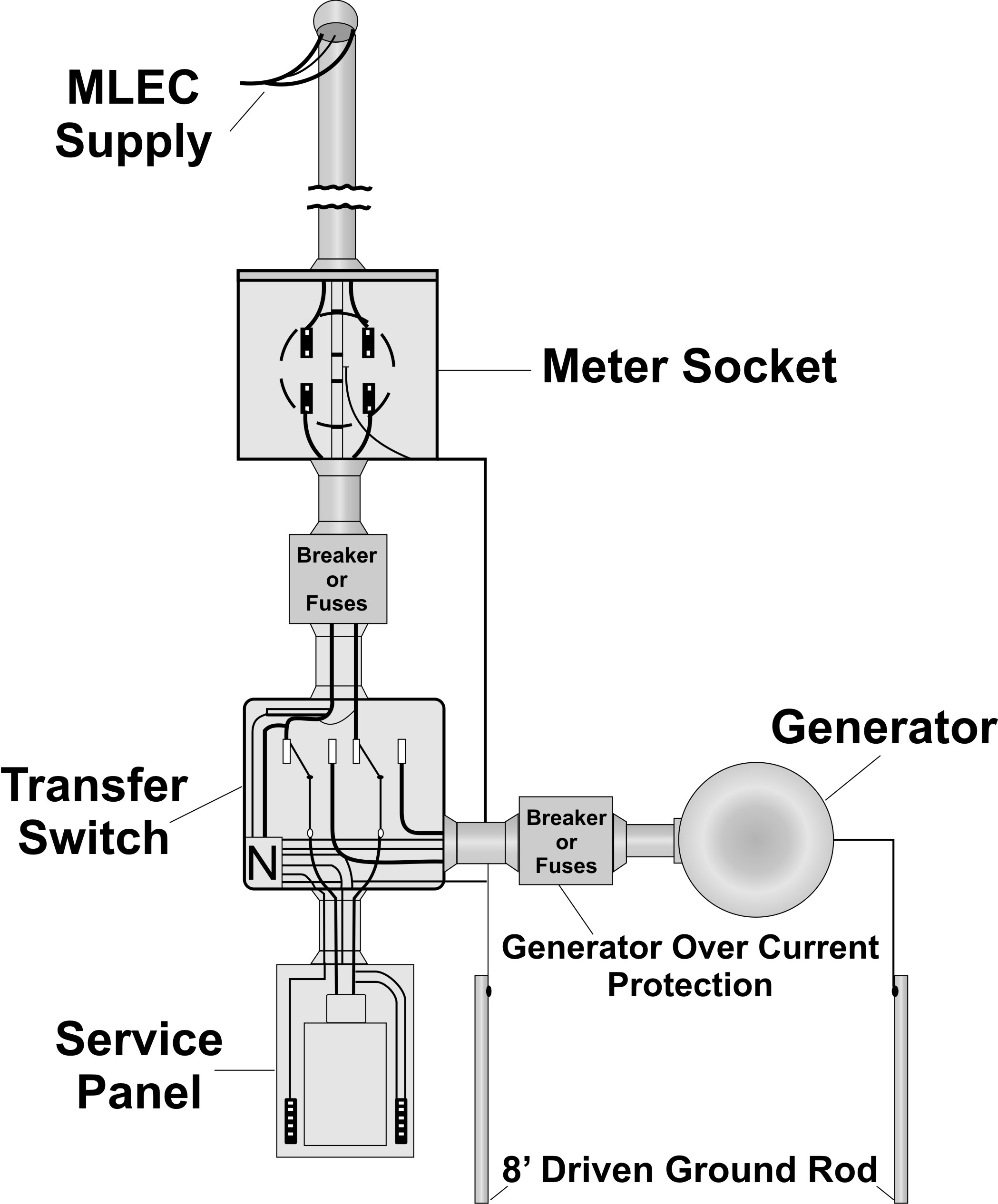
Typical installation for service entrance rated at 200 amperes or less
- Conductor sizes from generator to transfer switch will be determined by generator capacity.
- Over-current protection for the generator will be determined by generator capacity.
- A transfer switch*, such as a double-throw type that breaks contact of ungrounded conductors, should be installed in accordance with the current National Electrical Code. The neutral will not be broken by the switch. (*Switch must be listed by an OSHA Nationally Recognized Testing Laboratory such as Underwriter’s Laboratories.)
- Transfer switch will be bonded to the service entrance ground with #4 solid copper conductor.
- If the transfer switch is suitable for service equipment, the overcurrent protection between the meter base and the transfer switch is not required.
Portable Generator Safety Tips
- Never plug a portable generator into a regular household outlet.
- Never operate the portable generator in enclosed spaces.
- Use heavy-duty, outdoor-rated extension cords.
- Ensure your portable generator is properly grounded.
- Never overload a portable generator.
- Turn off all equipment powered by the portable generator before shutting the generator down.
- Always have a fully charged fire extinguisher nearby.
- Never fuel a portable generator while it is operating.